The Legacy of Joan of Arc
The Legacy of Joan of Arc

Much has been said and written about courage, and it has been represented in different ways throughout history. Art has chosen it as the topic of innumerable works; some have stood the test of time even up until now.
It has inspired verses, myths and elegies. Songs and odes have been intoned, in which heroes and legends try to embody bravery and daring towards a noble and glorious purpose, generally expressed in battle. However, a question remains:
What is the true nature of courage?
Are daring and bravery shown in the battlefield the only way in which it can be expressed as a virtue, or is it that courage can be found in the daily actions of ordinary people? Could it be that greatness can be found in the little things, strength in the apparent fragility?
Where can we start looking for examples of courage? Is this virtue represented in nature? The bamboo has strong and deep roots; it bends, but resists the strongest winds and storms with magnificent courage. As a symbol of masterful patience and perseverance, for seven years of apparent inactivity, underneath the earth it develops the bases that will enable it to stay strong and true to its nature for a long time.
Is courage based on physical strength? The legendary story of David and Goliath seems to contradict that logic. A young shepherd, without training in combat and with limited resources -only a stone-, was able to beat a strong and well-armed giant, who was supported by a big army. Determination was key in his victory. Convinced of a truth that for him was a reality for which he was willing to risk his life, as the words he directed to his enemy show:
“You come to me with a sword […], but I go against you in the name of […] the Lord.”
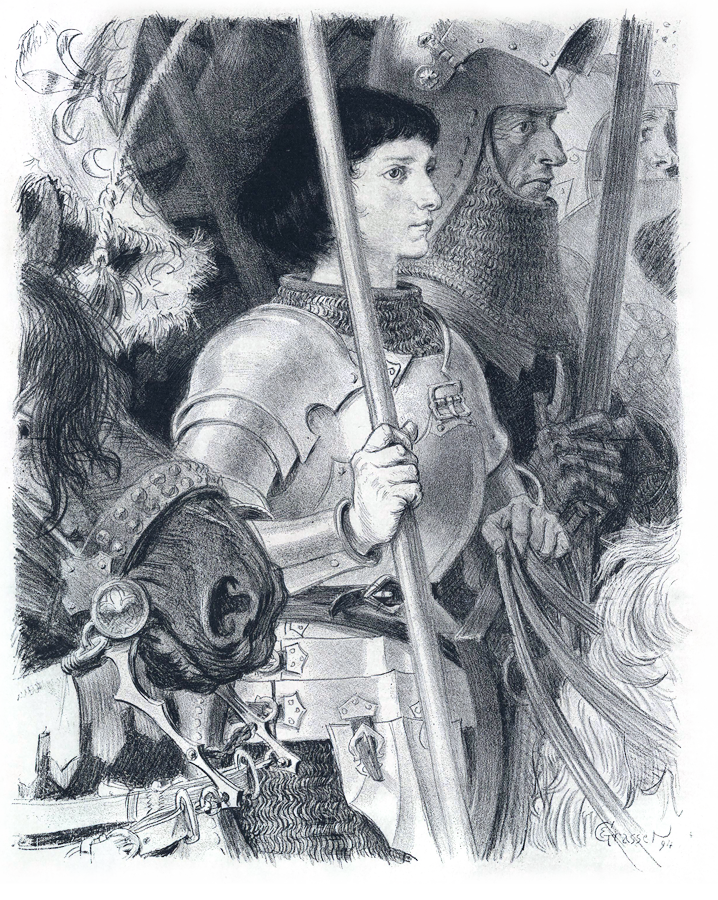
The life and deeds of a girl born in France in the 15th century, known as the Maid of Orleans, seem to answer these questions with particular emphasis. When she was fourteen years old, answering to a calling that resounded in her with inescapable force, she left her village without looking back and embarked on a colossal task, as if through her actions she could say
“Here I am. Send me”.
With simple origins, but possessing authentic nobility. Without experience or military training, driven by unwavering will and conviction. Delicate as a flower, but stronger than a thousand swords. Lacking the conditions that the powerful considered as requirements for a leader, she was an example of gentleness, candor and kindness. Through her actions, she led an army to victory and a people to their liberation. An inconceivable deed in any time, but carried out with the power of a recognized and accepted truth lived fully, which turned into her reason for living.
Why do we remember Joan? Why do we take up her legacy?
Like the subtle fluttering of a butterfly, our actions have unsuspected effects that echo to eternity. The echoes of Joan’s actions and the purpose that determined them persist and they are a source of inspiration to fight our own battles and execute our own epics -those that occur within ourselves. Today, we need the same courage to keep calm during a storm; to see beauty in the middle of darkness; to keep strong and worthy, pursuing what we know is correct, regardless of the tests. To overcome fear and to keep moving forward, with a firm step, looking straight ahead.
If we look carefully at the path Joan of Arc chose, if we can listen clearly to the echoes of her life, we may recognize in her the presence of the example of her master Jesus Christ who, as the time of his supreme test approached, was able to say with strong conviction:
“I have told you these things, so that in me you may have peace. In this world you will have trouble. But take heart, I have overcome the world.”