
Akhenaten and Monotheism
“You shine beautifully on the celestial horizon, O living Aten, whose name is great, whose titulary is sacred… you embrace and… envelop with your light as if made for a son of the living Aten, who grants to all, while people are not privileged with your vision…”
The above fragments were proclaimed by Akhenaten during the royal jubilee, an important celebration held in Karnak, where rituals took place to renew the relationships between humans and the divine. It was a special moment for the pharaoh, with the acclamation of Aten, the solar disk, as the only deity. It marked the peak of the religious reform that established monotheism in Ancient Egypt.
However, to better understand this event, it is worth recovering its historical context. Amenhotep IV proclaimed himself Akhenaten and ruled from 1353 to 1336 BCE. He was one of the last members of the powerful 18th Dynasty, which had led Egypt for nearly three hundred years.

Akhenaten and the royal family blessed by Aten, limestone relief from Tell el-Amarna, New Kingdom of Egypt, c. 1350 BCE – Egyptian Museum, Berlin.
This period, known as the New Kingdom (16th–11th century BCE), consolidated Egypt’s political and military power over regions of Asia Minor and Palestine to the north, and Nubia to the south. It was a time of internal political and social stability, and perhaps its greatest period of wealth.
By the time of Akhenaten’s monotheistic reform, two thousand years of Egyptian history had already passed, and the relationships between gods and humans had undergone many changes, since religious and political life were intrinsically linked. Pharaohs and priests moved the pieces on the board of the gods according to their needs or interests.
In Ancient Egypt, there was more than one concept of the creation of the world. On this theme, there were four major religious study centers: Memphis, Hermopolis, Thebes, and Heliopolis. Each of them, at different times, exerted its influence over the pharaohs and society as a whole. In Memphis, for instance, creation revolved around the god Ptah. In Hermopolis, the god Amun was central, just as he was in Thebes, where he reached his peak in the myth of creation. Heliopolis worshiped the Sun god. There, it was said that in the beginning, primordial waters existed, and from them emerged the first mountain, and from within it came forth the light, Ra, who replaced the darkness and took the form of the solar disk, Aten. From this manifestation, Aten-Ra, the self-fertilized creator demiurge, the other deities arose, and like a domino effect, everything that exists on Earth.
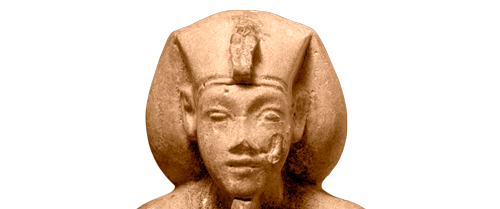

Throughout the 18th Dynasty, Thebes and Heliopolis, Amun and Aten, “vied” for influence over the pharaohs and society. Amenhotep III (Akhenaten’s father), for example, dedicated many monuments to the Sun god. Thus, the monotheism implemented by Akhenaten, centered on Aten-Ra, must be understood within a long-term historical context, in which this deity had been gaining importance among the Egyptian people.
The reform brought about a very radical change. Akhenaten and his wife Nefertiti, together with the priests who supported them, reshaped the rituals, built temples, created artistic representations, and founded a new capital, Akhetaten (Amarna).

The reform brought about a very radical change. Akhenaten and his wife Nefertiti, together with the priests who supported them, reshaped the rituals, built temples, created artistic representations, and founded a new capital, Akhetaten (Amarna).
The ancient concept of the eternal tension between order and chaos, represented in mythology by Maat and Isfet, respectively, gave way to a new principle that was to guide Egyptian society as a whole: good must prevail, as it is the greatest manifestation of Aten.
Monotheism, however, did not survive the pharaoh’s death. Most nobles, priests, and the people were not in favor of the religious reform. His successor, the young Tutankhamun, began the process of restoring polytheism. Amarna was abandoned, and all monotheistic representations were destroyed or erased. More than three millennia passed before archaeologists rediscovered its his story. The idea of monotheism had already been present among some Egyptians well before Akhenaten’s rise, but he was the one who officially instituted it for the entire kingdom.
Akhenaten’s reform was a courageous project of rupture and transformation. Despite the effort to erase his legacy, the strength of the Truth he brought endures to this day, making him one of the most remembered and influential pharaohs in History.

References
A revolução de Aquenáton, o faraó que acabou com 2 mil deuses e instaurou o monoteísmo no Egito. 2017. Available at: https://www.bbc.com/portuguese/geral-40602931 . Accessed on April 14, 2025.
CHAPOT, Gisela. O senhor da ordenação: um estudo da relação entre o faraó Akhenaton e as oferendas divinas e funerárias durante a Reforma de Amarna (1353-1335 a.C.). 2007. Available at: https://app.uff.br/riuff/bitstream/handle/1/17314/Dissert-2007_CHAPOT_Gisela-S.pdf?sequence=1&isAllowed=y . Accessed on April 14, 2025.
CARDOSO, Ciro F. S. De Amarna aos Ramsés. 2001. Available at: https://revistas.ufrj.br/index.php/phoinix/article/view/33266/18692 . Accessed on April 14, 2025.
CARDOSO, Ciro F. S. O politeísmo dos antigos egípcios sob o Reino Novo (1530-1069 a.C.). 2008. Available at: https://pt.scribd.com/document/397259992/O-politeismo-dos-antigos-egipcios . Accessed on April 14, 2025.

